
If you fly under instrument flight rules or rely on an altitude-reporting transponder, two Federal Aviation Regulations will shape how you maintain your aircraft: FAR 91.411 and FAR 91.413. These rules exist to ensure that the altimetry and transponder systems used in controlled airspace are accurate, reliable, and properly tested. But not every aircraft owner fully understands which aircraft fall under these requirements, what the inspections actually cover, and what happens if you skip them.
This guide breaks it all down in plain language.
Understanding the Purpose Behind 91.411 and 91.413
Before diving into which aircraft are affected, it helps to understand why these two regulations exist in the first place.
FAR 91.411 governs the inspection and testing of altimeter systems and altitude reporting equipment used in instrument flight. The FAA established this rule because inaccurate altitude readings in instrument meteorological conditions (IMC) can be catastrophic. When a pilot is flying without visual reference to the ground, the altimeter is one of the most critical instruments in the cockpit. If it is feeding incorrect data, or if the static system has a leak, the pilot and air traffic control could both be working from faulty altitude information.
FAR 91.413 governs transponder inspections. Transponders allow ATC to identify and track aircraft on radar. When a transponder is transmitting incorrect data, it creates hazards not just for the aircraft in question, but for every other aircraft operating in the same airspace. The FAA requires regular checks to confirm that transponders are operating within acceptable tolerances and transmitting accurate information.
Together, these two regulations form a critical layer of safety for aircraft operating in controlled airspace and under IFR conditions.
Which Aircraft Are Required to Comply With FAR 91.411?
FAR 91.411 applies to any aircraft operated under instrument flight rules (IFR). Specifically, the regulation states that no person may operate an aircraft in controlled airspace under IFR unless, within the preceding 24 calendar months, each static pressure system, each altimeter instrument, and each automatic pressure altitude reporting system has been tested and inspected and found to meet the requirements of the applicable appendix in FAR Part 43.
This means the rule is triggered by how the aircraft is being operated, not simply by what equipment is installed. If you fly a piston single under VFR only and never file an IFR flight plan, you are technically not required to have the 91.411 inspection completed. However, the moment you operate that same aircraft under IFR in controlled airspace, the rule applies and the inspection must have been completed within the past 24 calendar months.
That said, most aircraft equipped with an encoding altimeter or a Mode C transponder are practically speaking going to need this inspection if they are flown in busy airspace. The practical reality is that aircraft operating in Class A, B, or C airspace, or above 10,000 feet MSL in Class E airspace, are required to have Mode C capability under FAR 91.215. And if you have Mode C, you are feeding altitude data to ATC, which makes the accuracy of that data a serious concern. Most pilots who regularly fly in these environments keep the 91.411 inspection current regardless of whether every single flight is filed IFR.
Turbine-powered aircraft, transport category aircraft, and aircraft used in commercial operations under Part 135 or 121 also fall under this requirement, and often have additional inspection requirements layered on top of the FAR 91.411 baseline.
The inspection itself must be performed by a certificated repair station or a certificated mechanic with an airframe rating who also holds an inspection authorization (IA), or by the manufacturer. Pilots and regular airframe and powerplant (A and P) mechanics without an IA cannot perform or sign off on this inspection.
Which Aircraft Are Required to Comply With FAR 91.413?
FAR 91.413 is broader in its scope than 91.411. This regulation applies to any aircraft equipped with a transponder, regardless of whether the aircraft is operated IFR or VFR. The rule states that no person may use an ATC transponder unless, within the preceding 24 calendar months, the transponder has been tested and inspected and found to comply with the standards in Appendix F of FAR Part 43.
This is an important distinction. Unlike 91.411, which is triggered by IFR operations, 91.413 is triggered simply by the presence and use of a transponder. If your aircraft has a transponder and you turn it on, the regulation applies.
This means that a VFR-only Cessna 172 with a functioning Mode C transponder must have a current 91.413 inspection if the pilot intends to use that transponder. Because transponders are required for flight in Class B, C, and certain Class D and E airspace, most aircraft that regularly operate near airports or in congested areas will need a current transponder inspection.
Aircraft that do not have a transponder installed at all are not subject to FAR 91.413. Ultralight vehicles operating under FAR Part 103, and some experimental amateur-built aircraft operating exclusively in uncontrolled airspace without transponders, may fall outside the scope of this rule. However, any aircraft owner considering removing or disabling a transponder to avoid the inspection requirement should be aware that this also removes the ability to operate in transponder-required airspace, which is a significant operational limitation.
Like the 91.411 inspection, the 91.413 transponder check must be performed by a certificated repair station. This is one area where the two inspections differ slightly in terms of who can perform them. The transponder inspection has historically required a repair station, though operators should confirm current requirements with the FAA or an aviation maintenance professional.
How the Two Inspections Work Together in Practice
For most aircraft operating in the IFR environment, the 91.411 and 91.413 inspections are scheduled and completed at the same time. This makes practical sense because the equipment involved is interconnected. The encoding altimeter and the transponder work together to provide ATC with Mode C altitude reporting. Testing them together ensures the entire system is functioning correctly and gives the shop an opportunity to catch discrepancies that might not show up if each component were tested in isolation.
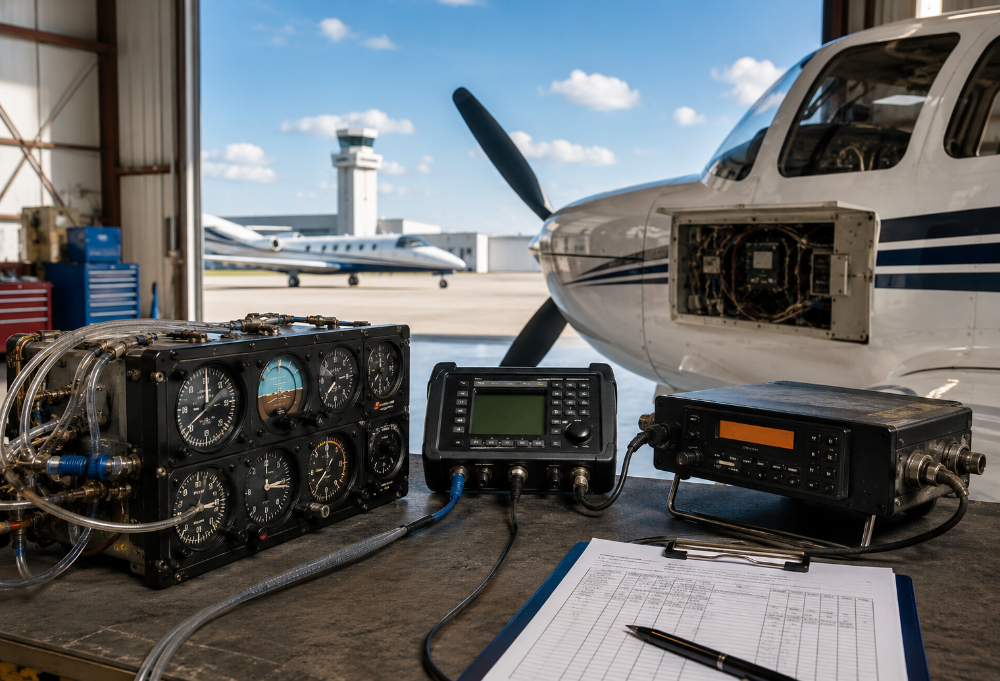
Many repair stations and avionics shops offer a combined pitot/static and transponder check as a package service. This test involves pressurizing the static system to simulate various altitudes, checking the altimeter for accuracy at multiple pressure points, inspecting the static lines and connections for leaks, and running the transponder through a series of radio frequency and output power tests.
The logbook entries for both inspections are critical. After a compliant inspection, the maintenance record must include the date, the results, and the signature of the person or repair station that performed the work. During an IFR flight review or an aircraft records check, these logbook entries are what prove compliance. Missing or incomplete entries can ground an aircraft even if the equipment is functioning perfectly.
Owners of glass cockpit aircraft and those with integrated avionics suites such as the Garmin G1000 or similar systems should not assume that newer equipment is exempt. The FAA requires the same 24-month inspection cycle regardless of how modern the avionics are.
Conclusion
FAR 91.411 and FAR 91.413 apply to a wide range of aircraft, from basic piston trainers to sophisticated turbine equipment. In short, if your aircraft is operated IFR, the 91.411 altimeter and static system inspection is required every 24 calendar months. If your aircraft has a transponder and you use it, the 91.413 inspection applies on the same schedule. Staying current with both inspections is not just a regulatory obligation; it is a straightforward commitment to accuracy and safety in shared airspace.
Need a Fixed-Base Operator in Dayton, OH?
To keep your aircraft compliant, accurate, and ready for safe operations in controlled airspace, we provide expert inspections and maintenance backed by decades of aviation experience at First Flight Aviation. As an FAA-certified repair station and Cirrus-authorized service center located at Dayton-Wright Brothers Airport, we offer comprehensive support for piston, turbine prop, and jet aircraft, along with full avionics, sheet metal, and line services in our state-of-the-art facility. Whether you need FAR 91.411 and 91.413 inspections, routine maintenance, or advanced aircraft support, our experienced team is committed to keeping you flying with confidence. Contact us today to schedule your appointment and see why pilots and aircraft owners have trusted us since 1981.