
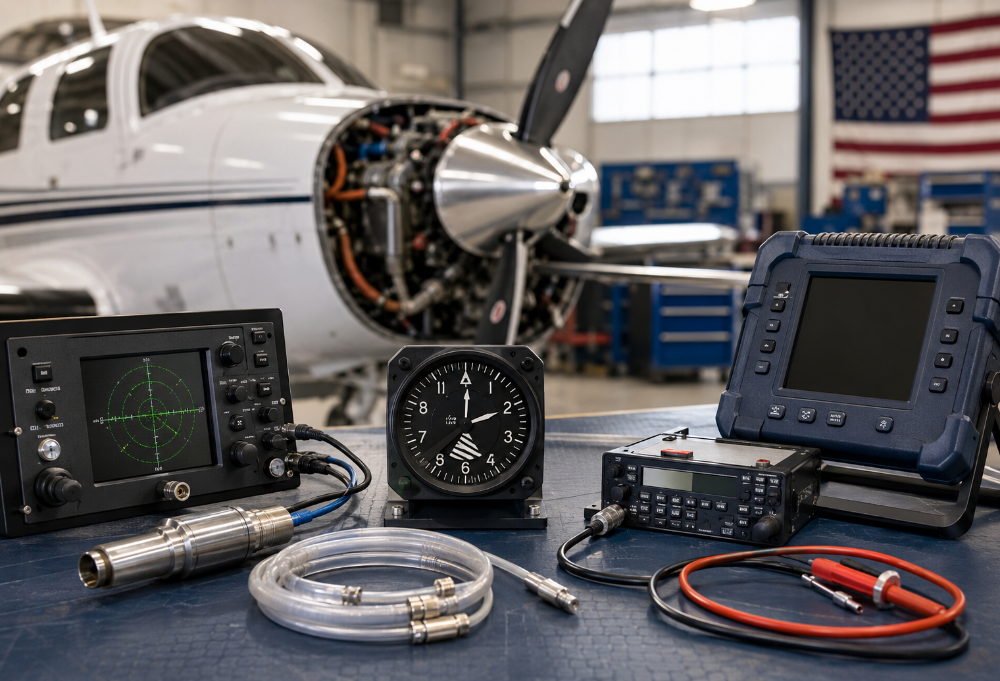
Staying compliant with Federal Aviation Regulations is not just a legal obligation but a matter of safety for everyone in the sky. Two of the most commonly misunderstood requirements are FAR 91.411 and FAR 91.413, which govern the inspection and certification of altimeter systems and ATC transponders. Whether you fly out of a busy regional airport or a small general aviation field, understanding these regulations and knowing where to find qualified certification services in Ohio can save you time, money, and serious regulatory headaches.
What FAR 91.411 Requires for Altimeter and Pitot-Static Systems
FAR 91.411 establishes the inspection requirements for altimeter systems and altitude reporting equipment used in controlled airspace. Under this regulation, no person may operate an aircraft in controlled airspace under instrument flight rules (IFR) unless the aircraft’s altimeter system and altitude reporting equipment have been tested and inspected within the preceding 24 calendar months.
The inspection must be performed by a certificated repair station or a certificated mechanic with an Airframe rating, following the procedures outlined in the appropriate appendixes of Part 43. The tests cover a range of critical functions, including scale error, hysteresis, friction, and the leak check of the entire pitot-static system. These checks are designed to ensure that the altimeter provides accurate readings under the pressures and altitudes encountered during flight.
For Ohio pilots operating under IFR, this is not an optional service. Failure to maintain a current 91.411 certification means the aircraft is technically not legal to operate in controlled airspace under instrument conditions. Many pilots assume that a passing annual inspection covers this requirement, but the altimeter and pitot-static system test is a separate, dedicated certification with its own documentation requirements.
What FAR 91.413 Requires for ATC Transponders
FAR 91.413 addresses the inspection and testing of ATC transponders. This regulation requires that any transponder installed in an aircraft be tested and inspected within the preceding 24 calendar months before the aircraft is operated in controlled airspace. Unlike FAR 91.411, this requirement applies to virtually all aircraft operating in controlled airspace, not just those flying under IFR.
The transponder test must be conducted by a certificated repair station with appropriate ratings. The tests verify that the transponder is transmitting accurate altitude information, responding correctly to interrogations, and operating within the tolerances specified in FAR Part 43, Appendix F. For aircraft equipped with ADS-B Out systems, the testing process also incorporates checks on position source accuracy and the integrity of the data being transmitted.
Ohio has a growing number of aircraft operating with glass cockpit technology and ADS-B Out equipment, which has made transponder certification services more technically demanding in recent years. Repair stations that specialize in avionics are particularly well suited to handle these more complex systems, as they have the specialized test equipment and trained technicians required by regulation.
Finding Qualified Certification Services in Ohio
Ohio is home to a robust general aviation community, with hundreds of registered aircraft and dozens of certified repair stations spread across the state. Cities like Columbus, Cleveland, Cincinnati, Dayton, and Akron serve as hubs for aviation maintenance activity, with both large full-service facilities and smaller specialty avionics shops available to aircraft owners.
When searching for a repair station to perform your 91.411 and 91.413 certifications, the most important credential to look for is FAA certification under FAR Part 145. A Part 145 repair station has been audited by the FAA and holds specific ratings that authorize it to perform particular types of work. For pitot-static and transponder testing, you want to confirm the shop holds the appropriate avionics or instrument ratings.
It is also worth asking whether the facility has calibrated test equipment that is traceable to NIST (National Institute of Standards and Technology) standards. The accuracy of a 91.411 or 91.413 test is only as good as the equipment performing it, and reputable shops will be able to provide calibration records for their test sets. Ohio aircraft owners should also check whether the repair station can issue the required maintenance record entries and logbook sign-offs, as these documents are what prove your compliance during an FAA ramp check or before an IFR flight.
Many Ohio airports have on-site maintenance facilities that offer these services, but availability can vary significantly. Smaller general aviation airports may have shops that focus on airframe and engine work but lack the specialized equipment for avionics certification. In those cases, flying to a nearby metropolitan area or scheduling a mobile avionics technician may be the most practical option.
Planning Your Certification Schedule
One of the most common mistakes Ohio aircraft owners make is waiting until the last minute to schedule their 91.411 and 91.413 inspections. These certifications expire on a 24-calendar-month cycle, meaning that if your tests were completed in March 2024, they expire at the end of March 2026, regardless of how many hours the aircraft has flown in the interim.
Building a proactive maintenance calendar that tracks both your annual inspection and your avionics certification dates is a smart practice. Many pilots coordinate their 91.411 and 91.413 certifications with their annual inspection to minimize downtime and reduce the number of trips to the shop. However, this only works if the shop performing the annual also has the capability and ratings to conduct the pitot-static and transponder tests. Confirming this in advance prevents the frustrating situation of having a freshly completed annual inspection but still being grounded because the avionics certifications lapsed.
For Ohio flight schools and flying clubs, the stakes are even higher. Aircraft used for instrument training must be in full compliance at all times, and an expired 91.411 or 91.413 certification can ground an aircraft immediately, disrupting student schedules and costing the organization revenue. Designating a maintenance coordinator who tracks all compliance deadlines is a worthwhile investment for any organization operating multiple aircraft.
Common Pitfalls and How to Avoid Them
Even experienced Ohio pilots can run into compliance problems with FAR 91.411 and 91.413 if they are not paying close attention to the details. One of the most frequent issues is relying on outdated logbook entries without verifying the actual certification date. If an aircraft has changed hands, it is critical to review all available maintenance records and confirm that the certifications are current, because the previous owner’s documentation may be incomplete or unclear.
Another common pitfall involves aircraft modifications. If any component of the pitot-static system or the transponder installation has been altered or replaced since the last certification, a new test is required before the aircraft can return to IFR operations in controlled airspace. This includes seemingly minor changes like replacing a static port, installing a new altitude encoder, or upgrading to a new transponder unit. Failing to recognize these triggers for a fresh certification is a mistake that can put a pilot in violation without even realizing it.
Leaks in the pitot-static system are another concern that sometimes surfaces during 91.411 testing. Ohio’s significant seasonal temperature swings can stress plumbing connections and flexible tubing over time, and small leaks that might not affect visual flight operations can cause meaningful altimeter errors at IFR altitudes. Catching these issues during routine certification testing is exactly the kind of proactive safety benefit the regulation was designed to deliver.
Conclusion
FAR 91.411 and 91.413 certifications are foundational to safe and legal IFR operations in Ohio. Staying current on these requirements, working with qualified Part 145 repair stations, and planning your maintenance schedule proactively will keep your aircraft airworthy and your flying uninterrupted.
Need a Fixed-Base Operator in Dayton, OH?
At First Flight Aviation, we understand how important it is to keep your aircraft compliant, safe, and ready for flight. Our experienced team provides reliable FAR 91.411 and 91.413 certification services backed by decades of aviation expertise, advanced avionics capabilities, and our FAA-certified repair station status. From turbine prop engines and jet aircraft to reciprocating engines, we are committed to delivering the dependable service Ohio pilots and aircraft owners deserve. Contact us today to schedule your certification appointment and let our team help keep your aircraft operating at its best.