
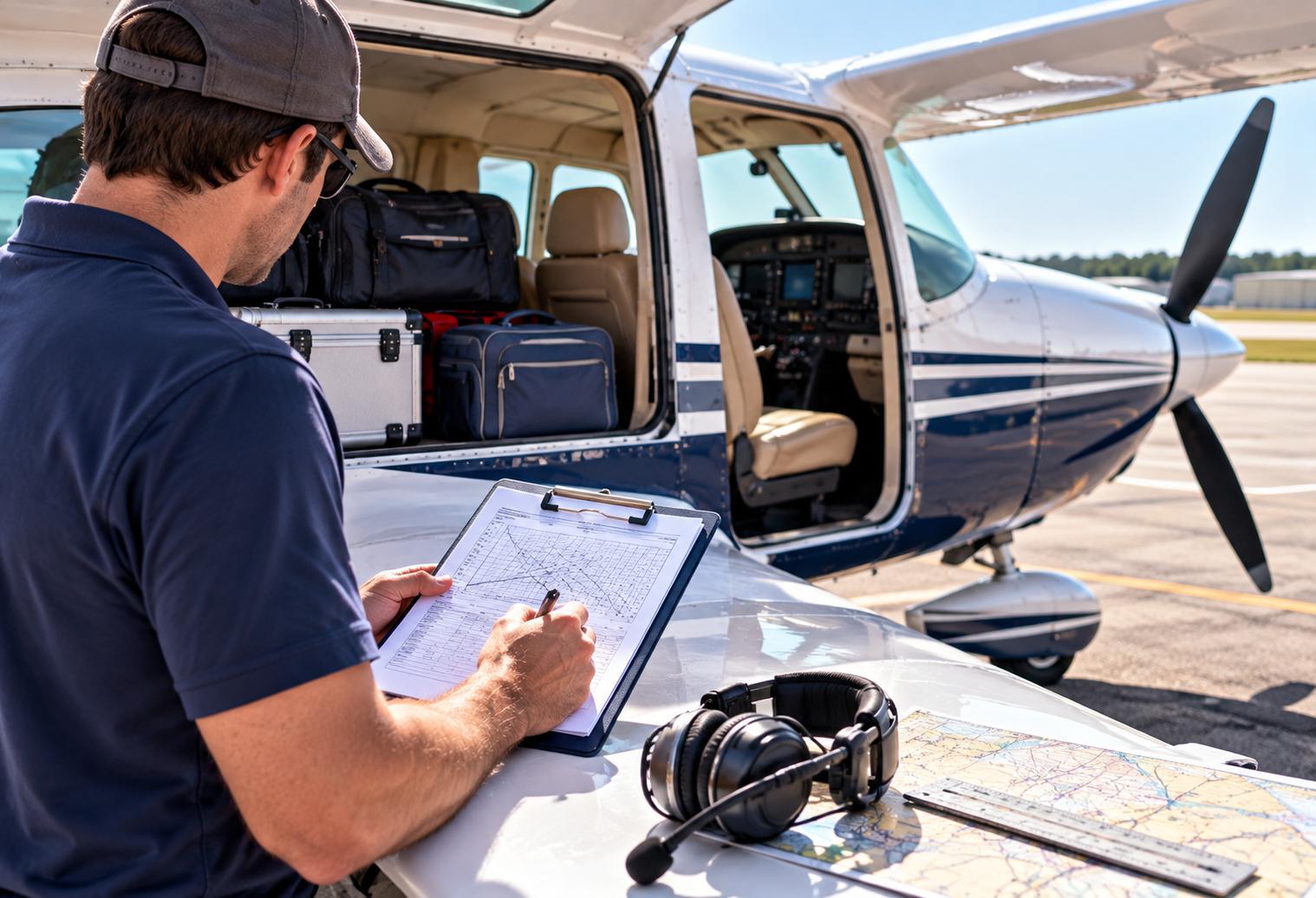
In a city known as the Birthplace of Aviation, safe flight still starts with the fundamentals. For pilots flying in and around Dayton, understanding aircraft weight and balance is one of the most important parts of preparing an airplane before leaving the ground.
Weight and balance affects far more than whether everything physically fits inside the aircraft. It influences takeoff performance, climb capability, stall characteristics, stability, and control.
Quick answer: Aircraft weight and balance matters because an airplane must remain within both its approved maximum weight and center of gravity limits to operate as designed. Loading too much total weight or placing passengers, baggage, fuel, or equipment in positions that move the center of gravity outside the approved range can negatively affect aircraft performance and controllability.
The Federal Aviation Administration treats weight-and-balance planning as a fundamental part of safe aircraft operation. Pilots should verify the numbers for the specific aircraft and flight rather than relying on assumptions about whether the load “looks fine.”
What Dayton Pilots Should Know About Weight and Balance
Aircraft weight and balance is a flight-specific calculation, so pilots should consider the airplane, occupants, baggage, fuel, and planned conditions before every applicable flight.
-
Maximum allowable weight and acceptable center of gravity are separate limitations, and an aircraft must satisfy both.
-
Fuel, passengers, baggage, and equipment can all change an aircraft’s total weight and center of gravity.
-
Pilots operating around Dayton-Wright Brothers Airport, Dayton International Airport, and other regional airports must consider weight and balance along with runway and weather conditions.
-
Adding another passenger or extra baggage can affect a smaller training or general aviation airplane more significantly than many new pilots expect.
-
A loading arrangement that works for one flight may not work for another, even in the same aircraft.
Why Weight and Balance Matters for Flying in Dayton
Weight and balance matters locally because pilots in the Dayton region operate within an active and varied aviation environment that includes training, personal, corporate, commercial, and military aviation.
Dayton’s connection to aviation runs from the Wright brothers and Huffman Prairie to modern facilities such as Dayton International Airport, Dayton-Wright Brothers Airport, and Wright-Patterson Air Force Base. Dayton-Wright Brothers Airport in Miami Township primarily serves corporate and personal aircraft and functions as a general aviation reliever airport for Dayton International Airport.
That makes sound preflight decision-making especially relevant for student pilots and general aviation pilots throughout Montgomery County and surrounding communities such as Miamisburg, Centerville, Kettering, Beavercreek, and Vandalia.
For pilots learning with First Flight Aviation, understanding the reasoning behind weight-and-balance calculations can help turn the process from a checklist exercise into a meaningful part of aeronautical decision-making.
What FAA Guidance Says About Weight and Balance
FAA guidance says safe loading requires pilots to keep the aircraft within its approved total weight and center of gravity range.
The FAA Weight & Balance Handbook explains two fundamental considerations. The aircraft’s total weight must remain within the allowable maximum, and its center of gravity must remain within the approved range for its operating weight.
The FAA also emphasizes that operating weight includes more than the airplane itself. People, baggage, cargo, and fuel all affect the calculation. The correct limits and loading information for a particular aircraft come from that aircraft’s approved documentation, such as its Pilot’s Operating Handbook or Airplane Flight Manual and current weight-and-balance records.
How Excess Weight Affects an Aircraft
Excess aircraft weight can reduce performance at exactly the time pilots may need performance most, particularly during takeoff and climb.
An overloaded airplane may require a longer takeoff distance, climb more slowly, have a higher stall speed, and provide less margin for obstacle clearance. Those effects can become especially important when runway length, temperature, wind, aircraft condition, or other performance factors are unfavorable.
For pilots departing airports across the Miami Valley, the important lesson is not to think of maximum gross weight as the only planning number. Actual operating conditions still matter when deciding whether the planned flight provides an appropriate performance margin.
How Center of Gravity Affects Aircraft Control
Center of gravity affects stability and control because the location of the aircraft’s load changes how the airplane responds in flight.
A center of gravity that is too far forward can require greater control force and may reduce the pilot’s ability to raise the nose sufficiently under certain conditions. A center of gravity that is too far aft can reduce longitudinal stability and make stall recovery more difficult.
An aircraft can therefore be below its maximum allowable weight and still be improperly loaded. That distinction is especially important for student pilots learning to move beyond simple “total pounds” thinking.
Warning Signs That a Weight-and-Balance Review Is Especially Important
A careful weight-and-balance calculation is especially important whenever the aircraft’s normal loading arrangement changes.
Watch for situations such as:
-
Carrying a passenger who does not normally fly in the aircraft.
-
Adding or removing baggage from the baggage compartment.
-
Flying with significantly different fuel quantities than usual.
-
Carrying equipment that changes the normal loading arrangement.
-
Filling multiple seats in a training or light general aviation aircraft.
-
Moving baggage or other permitted items from one approved location to another.
-
Using an aircraft after equipment changes that may have altered its empty weight or moment.
-
Discovering that the planned loading is close to a maximum weight or center of gravity limit.
A familiar airplane should never become a reason to skip the calculation when loading conditions have changed.
When Should a Pilot Recalculate Weight and Balance?
Pilots should calculate or verify weight and balance whenever needed to confirm that the aircraft will remain within its approved limitations for the planned operation.
Safe planning begins with current information for the specific aircraft. Pilots should use the approved aircraft data rather than estimates carried over from another airplane of the same model.
If aircraft records appear incomplete, equipment changes are not properly reflected, or the pilot cannot confidently determine the aircraft’s loading condition, that uncertainty should be resolved before flight with an appropriately qualified instructor, mechanic, or other aviation professional as applicable.
Common Causes of Weight-and-Balance Problems
Weight-and-balance problems commonly result from incorrect assumptions about passengers, baggage, fuel, or the aircraft’s current empty weight.
1. Estimating Instead of Calculating
A load that looks reasonable may still fall outside an approved limit. Using the correct numbers is more reliable than judging the airplane by appearance.
2. Focusing Only on Maximum Weight
An aircraft may be below maximum gross weight while its center of gravity is outside the approved envelope. Both limits must be checked.
3. Forgetting the Effect of Baggage Location
The same amount of baggage can have different effects depending on where it is placed because distance from the aircraft datum changes its moment.
4. Using Outdated Aircraft Information
Repairs, alterations, and equipment changes can affect aircraft weight-and-balance data. Calculations should begin with the correct current records for that aircraft.
5. Treating Fuel as a Fixed Number
Fuel is part of the aircraft’s load and changes during flight. Pilots should understand how fuel quantity affects total weight and, when applicable, center of gravity throughout the planned operation.
How Pilots Can Build Better Weight-and-Balance Habits
Good weight-and-balance habits begin with using the same disciplined process during routine flights that a pilot would use for an unusual loading situation.
Before flying from the Dayton area, pilots can review current aircraft data, obtain realistic passenger and baggage weights, determine fuel requirements, calculate total weight and moment, and confirm that the center of gravity remains within the approved envelope.
Student pilots should also practice changing hypothetical loads. Move a passenger, add baggage, reduce fuel, or change seating positions and observe what happens to the numbers. That exercise helps explain why aircraft loading is about both weight and location.
What Pilots Should Expect From Proper Preflight Planning
Proper weight-and-balance planning should give the pilot a clear numerical answer about whether the planned aircraft loading falls within approved limits.
The calculation does not guarantee a safe flight by itself. Weather, runway conditions, aircraft performance, pilot proficiency, fuel planning, and other factors remain part of the overall go or no-go decision.
For pilots around Dayton and Montgomery County, weight and balance should work alongside those other preflight considerations rather than being treated as an isolated paperwork requirement.
Common Weight-and-Balance Mistakes to Avoid
Common mistakes are preventable when pilots use current aircraft information and verify each part of the planned load.
Mistake: Assuming four available seats means four occupants can always be carried.
Consequence: The aircraft may exceed its maximum weight or center of gravity limits.
Better approach: Calculate the actual proposed load for the specific aircraft.
Mistake: Checking total weight but not center of gravity.
Consequence: The aircraft may be under maximum weight but improperly balanced.
Better approach: Confirm both total weight and CG position.
Mistake: Reusing numbers from a previous flight without checking today’s loading.
Consequence: Changes in passengers, baggage, or fuel can make the old calculation inaccurate.
Better approach: Verify the actual conditions for the planned flight.
A Common Dayton-Area Training Scenario
A common local scenario is a pilot planning a flight with a different passenger and baggage combination than normally carried.
Imagine a training aircraft preparing to depart the Dayton area with two occupants, fuel, and baggage for a longer flight. The pilot may discover that the airplane remains below maximum weight but that the baggage location shifts the calculated center of gravity closer to a limit.
The correct response is not to assume the difference is insignificant. The pilot should use the aircraft’s approved information and adjust the permitted loading as necessary before departure.
This is a representative training scenario, not a description of a specific First Flight Aviation flight.
How Flight Training Supports Better Preflight Decisions
Quality flight training helps pilots understand why weight-and-balance calculations matter instead of simply teaching them to complete a formula.
Working through realistic loading scenarios can help students connect aircraft limitations with takeoff performance, stability, stall behavior, fuel planning, and aeronautical decision-making.
Comparing a Quick Estimate With a Proper Calculation
A proper weight-and-balance calculation is the appropriate way to verify aircraft loading because visual estimates cannot confirm compliance with approved limits.
A quick glance may tell a pilot that the aircraft appears heavily loaded, but it cannot determine the actual center of gravity or confirm the remaining weight margin. Using current aircraft data and actual loading information provides a defensible answer before flight.
For student pilots, learning to perform the process carefully also develops habits that remain useful as aircraft, passengers, and missions become more complex.
Where This Matters Around the Dayton Area
Weight-and-balance fundamentals apply to pilots operating throughout the Dayton region, including Montgomery County and nearby communities such as Kettering, Centerville, Miamisburg, Beavercreek, and Vandalia.
Whether operating near Dayton-Wright Brothers Airport, Dayton International Airport, or elsewhere in the Miami Valley, the aircraft’s approved limitations remain the starting point for a safe loading decision.
What Can Happen If Weight and Balance Is Ignored?
Ignoring weight and balance can reduce aircraft performance, stability, and controllability while leaving the pilot with less safety margin during critical phases of flight.
The consequences can include longer takeoff distances, reduced climb performance, higher stall speeds, poor handling characteristics, and difficulty maintaining or recovering proper aircraft control.
These are reasons to treat the calculation as part of flight planning, not simply as a training requirement.
Frequently Asked Questions About Aircraft Weight and Balance
Aircraft weight-and-balance questions usually come down to understanding how total weight, load location, fuel, and approved aircraft limitations interact.
Do I need to calculate weight and balance for every flight in Dayton?
Pilots need to ensure the aircraft is within approved weight-and-balance limitations for the planned operation. Whether a full calculation is needed depends on the aircraft and circumstances, but changed passengers, baggage, fuel, or equipment are strong reasons to verify the numbers rather than assume a previous loading condition still applies.
Can an airplane be under maximum weight but still be unsafe to fly?
Yes. An aircraft can be below its maximum allowable weight while its center of gravity is outside the approved range. That is why pilots must evaluate both total weight and CG position. Staying under the maximum weight alone does not confirm that the aircraft is properly loaded.
Does baggage really make a major difference in a small airplane?
Yes, baggage can make a meaningful difference because both its weight and location affect the aircraft’s loading. In smaller general aviation aircraft commonly used for personal flying or training, even a relatively modest loading change can alter total weight and the calculated center of gravity.
Why should Dayton student pilots learn weight and balance early?
Dayton student pilots benefit from learning weight and balance early because it connects several important aviation concepts, including aircraft performance, stability, stalls, fuel planning, and aeronautical decision-making. Practicing these calculations also helps students understand why apparently small loading changes can matter before a flight.
Where do pilots find the correct weight-and-balance limits?
Pilots should use the approved documentation and current records for the specific aircraft they intend to fly. Depending on the aircraft, relevant information may be found in the Pilot’s Operating Handbook, Airplane Flight Manual, approved supplements, and current weight-and-balance documentation.
Does burning fuel change aircraft weight and balance?
Yes. Burning fuel reduces aircraft weight, and depending on the aircraft’s fuel tank location and design, it may also change center of gravity. Pilots should use the aircraft manufacturer’s approved information to understand how fuel consumption affects the specific airplane throughout a flight.
Is weight and balance different from aircraft performance planning?
Yes, but the two are closely connected. Weight and balance determines whether the aircraft is loaded within approved limitations, while performance planning considers factors such as takeoff distance, climb performance, runway conditions, temperature, and other operating conditions. Dayton-area pilots should consider both during preflight planning.
Can a flight instructor help me understand weight and balance?
Yes. A flight instructor can help a student understand the calculation process, aircraft documentation, center of gravity concepts, and the practical consequences of different loading arrangements. Working through realistic examples is often useful for connecting the mathematics with what the airplane is actually doing.
Build Safer Preflight Habits in Dayton
Understanding aircraft weight and balance helps pilots make better decisions before the wheels ever leave the runway. In Dayton’s aviation community, that attention to fundamentals continues a long local tradition of learning how aircraft fly and how to operate them responsibly.
Strengthen Your Preflight Decision-Making
Build confidence by understanding the reasons behind the numbers, not just completing the calculation.